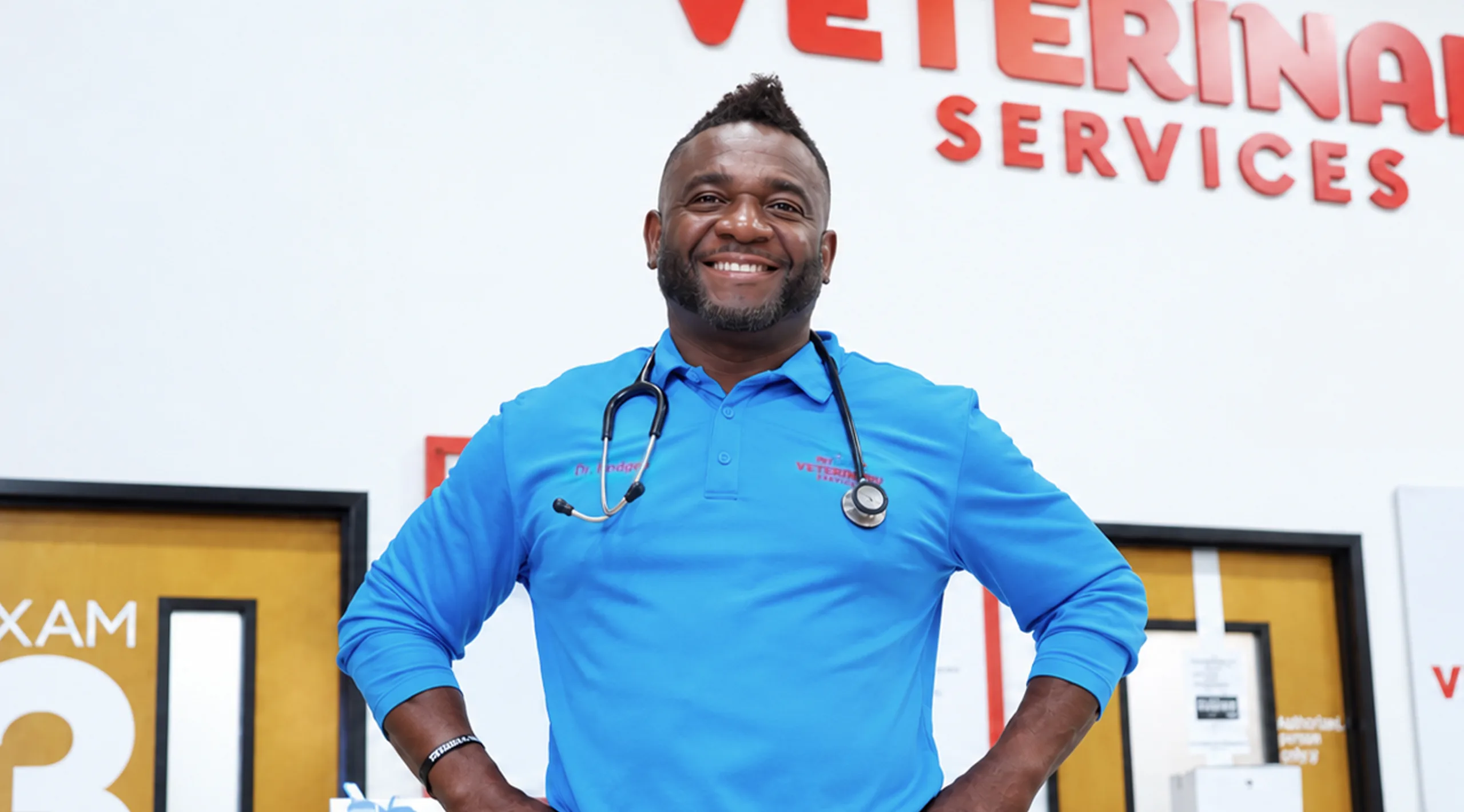
Dr. Vernard Hodges didn’t take the usual path to veterinary hospital ownership. In 1999, as a recent DVM graduate, he decided he would build his own hospital in order to stay near his hometown in rural Georgia. And we mean “build” literally.
“I went down to Lowe’s and bought some lumber,” Dr. Hodges told PetSmart Veterinary Services. “Then this guy outside of Birmingham, Alabama, was selling old cages, so I got those. I found an X-ray machine from World War II. It still worked!”
The location for his new hospital? An old paint shop. He used the lumber he purchased to construct his own exam rooms. Throughout the remodel, he had no idea whether his idea would work. “It probably wasn’t the smartest thing in the world,” he conceded, “but I thought, ‘If I build it, they will come.’”
The hard work paid off. Dr. Hodges and his veterinary school classmate and longtime friend, Dr. Terrence Ferguson, opened Critter Fixer Veterinary Hospital together. Within a year, they had a functioning, sustainable veterinary practice. The two would later bring their small-town veterinary operation to a global audience as the hosts of National Geographic’s Critter Fixers: Country Vets. Nearly 30 years later, they continue to work side by side. “We’ve never had an argument,” Dr. Hodges affirmed.
The modern reality
The landscape of veterinary medicine has changed dramatically since Dr. Hodges built his hospital from the ground up. Many new DVM graduates find themselves saddled with hundreds of thousands of dollars of debt, and corporate practices are eager to acquire new talent with promises of high salaries and impossible-to-ignore signing bonuses.
“Kids come out of school and they’re trying to figure out how to pay for it,” Dr. Hodges said. “But the economics of it are, if somebody’s going to give you a fifty-thousand-dollar bonus, that money has to come from somewhere.”
Dr. Hodges cautions that large signing bonuses can sometimes reflect productivity expectations and demanding caseloads that may affect the broader hospital team. To reduce costs and increase revenue, corporate practices may also limit the care a doctor can provide or require procedures that may not always be medically necessary. As a practice owner, Dr. Hodges enjoys the freedom to take a more personal approach. “I know the love I show my pet parents,” he said.
He believes so strongly in the benefits of practice ownership that he has now helped several other veterinarians become hospital owners through PetSmart Veterinary Services. He has partnered with veterinarians operating five hospitals across three states: three in his home state of Georgia, one in Pennsylvania, and one in Texas. This has given him the opportunity to provide the guidance he didn’t receive himself as a young DVM graduate.
Leadership is learned
“I was probably not the best boss in the world,” Dr. Hodges said, recounting the early days of his hospital. His approach to staffing and management was much looser then. Recruiting was “as simple as driving through McDonald’s and saying, ‘Hey, you want to work with puppies and dogs?’”
“But you’d go through them, too,” he added, referencing the high turnover his hospital experienced. “And a lot of that could have been me learning how to be a boss. I probably thought it was my way or the highway.” But in time, he started to understand that good leadership required give and take. “I am happy to say, I have one employee who’s been with me for twenty-five years. My anesthesiologist has been here seventeen years.” His next-longest-tenured staff member has been with him for 12 years, with several others in the six-to-eight-year range.
What’s his most important leadership advice for new doctor-owners? Don’t underestimate the power of the check-in. Dr. Hodges practices this approach not only in his own hospital, but also with his PVS partner veterinarians in Georgia, Texas and Pennsylvania. As they couldn’t easily meet in person, he went for the next best thing: a group call once a week, where all the veterinarians get together to go over numbers, talk about their cases and learn from each other. On these calls, Dr. Hodges always makes sure to ask, “What was your win for the week?” That question, he explained, proved more meaningful than he initially realized. It draws attention to the positives, reminds people that they are working in the career they dreamed of — and that no matter how difficult it gets, there are always reasons to be proud, happy and thankful.
Surviving burnout
“Burnout is real,” Dr. Hodges acknowledged. “Veterinary medicine is a tough field. It’s a great field, but a tough one. It’s not always about money. Sometimes it’s job satisfaction. Sometimes it’s the clients.”
His advice for new or aspiring vets? Get a mentor. “Oftentimes, we find ourselves isolated and we’re just in our own minds. Find that Mentor. Find somebody. You just have to get through those growing pains. Talk to somebody, and you’ll get through them.”
He also drew attention to the importance of taking time for what really matters in your life. Veterinarians are deeply passionate about their work, but that passion can also make it easy to fall into a workaholic trap — something that can be exacerbated by hospital ownership. “I remember getting up several Christmases and going into the office,” Dr. Hodges recalled. “I remember going in on New Year’s Eve, in a tuxedo, and working with a dog that was hit by a car. I remember missing certain things with my family.”
He credits one particular moment with changing his perspective on work. He came home one night to find his uncle sitting on the floor, playing with a Matchbox car with Dr. Hodges’ then 5-year-old son. “I had never done that. I had bought the cars, watched him play, but never gotten down on the floor myself. And I realized, he’s only going to be five one time. That was a eureka moment.”
The unique franchise ownership model offers independence within a framework of support, taking much of the back-office workload off of the doctor’s shoulders.
This is one reason why Dr. Hodges chose PetSmart Veterinary Services when he decided to partner with other veterinarians to help them open their own hospitals. The unique franchise ownership model offers independence within a framework of support, taking much of the back-office workload off of the doctor’s shoulders. Doctor-owners are also free to staff their hospitals as they see fit, bringing on practice managers or associate doctors to further reduce the burden. The result is an ownership opportunity that helps keep veterinary medicine in the hands of doctors, not profit-motivated corporations, while improving job satisfaction and reducing burnout.
With in-store hospitals designed and equipped to meet each doctor-owner’s needs, the process is considerably easier than constructing exam rooms from scratch.
It may seem like mentoring five other doctor-owners while still running his own hospital would leave Dr. Hodges with even less free time than before. But thanks to all the lessons he’s learned over the years, he’s much better at managing his time these days. When asked if he goes into the hospital on Christmas anymore, he replied, “Absolutely not.”